
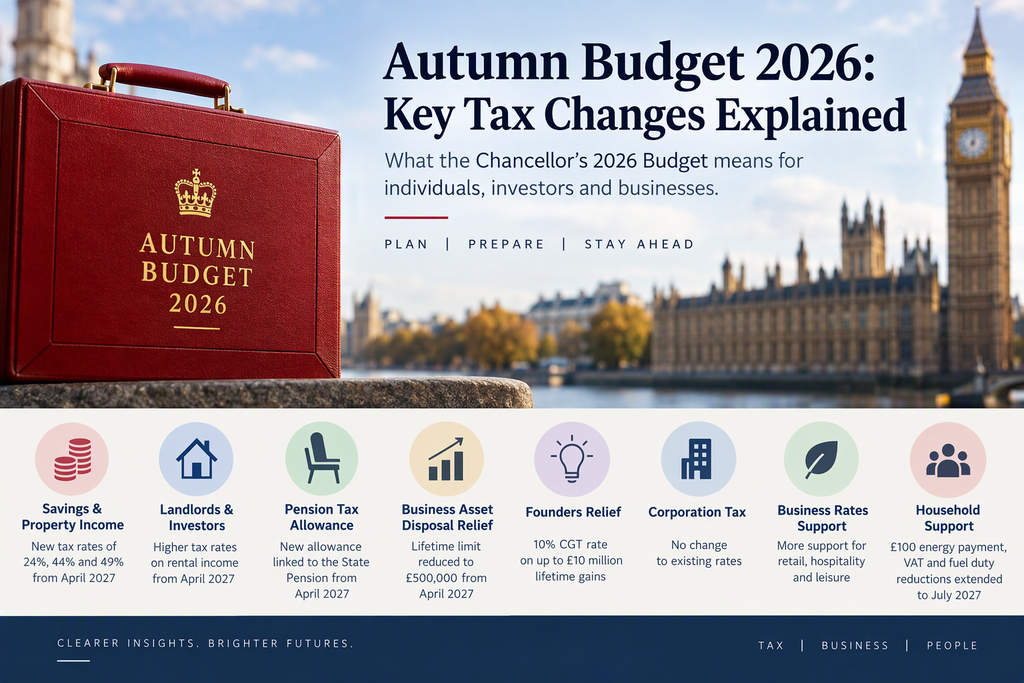
The Chancellor’s Autumn Budget 2026 focuses on providing support to households and businesses while maintaining fiscal discipline. Although the headline rates of Income Tax, National Insurance and Corporation Tax remain unchanged, several important tax measures will affect individuals, landlords, investors and business owners from April 2027 onwards.
Summary of the Main Tax Changes
.
| Measure | Current Position | New Position |
| Savings Income Tax | Standard Income Tax rates | 24% basic rate, 44% higher rate, 49% additional rate from April 2027. |
| Property Income Tax | Standard Income Tax rates | 24% basic rate, 44% higher rate, 49% additional rate from April 2027. |
| Pension Tax Allowance | No equivalent allowance | New allowance linked to the annual State Pension from April 2027. |
| Business Asset Disposal Relief (BADR) | £1 million lifetime limit | £500,000 lifetime limit from April 2027. |
| Founders Relief | Not available | 10% CGT rate on up to £10 million lifetime gains for qualifying founders. |
| Corporation Tax | Existing rates | No change. |
| Fuel Duty | 5p temporary reduction | Extended until 1 July 2027 |
Higher Tax Rates on Savings and Property Income
One of the most significant announcements for investors and landlords is the introduction of separate tax rates for savings and property income.
From April 2027:
| Taxpayer | New Rate |
| Basic Rate Taxpayer | 24% |
| Higher Rate Taxpayer | 44% |
| Additional Rate Taxpayer | 49% |
These changes will affect individuals receiving:
• Rental income
• Bank interest
• Building society interest
• Certain investment income streams
Landlords and higher-rate taxpayers are likely to experience the greatest increase in tax liabilities.
New Pension Tax Allowance
The government has introduced a new Pension Tax Allowance linked to the annual amount of the New State Pension.
The aim is to ensure pensioners whose income is at or below the level of the State Pension are not brought into the Income Tax system simply because annual pension increases exceed tax thresholds.
Impact
• Protects lower-income pensioners from fiscal drag.
• Supports pensioners benefiting from State Pension uprating.
• Reduces the risk of unexpected tax liabilities.
Business Asset Disposal Relief (BADR)
Business owners planning a future company sale should take particular note of this change.
| Current | From April 2027 | |
| Lifetime BADR Limit | £1,000,000 | £500,000 |
The reduction effectively halves the amount of gains eligible for the favourable BADR rate. Entrepreneurs considering a disposal may wish to review succession and exit plans before the changes take effect.
New Founders Relief
To encourage entrepreneurship and innovation, the Budget introduces a new Founders Relief.
Key Features
| Measure | Relief Available |
| CGT Rate | 10% |
| Lifetime Gain Limit | £10 million |
The relief is expected to apply to founders of qualifying high-growth and innovative businesses, offering a potentially significant tax advantage on the eventual sale of a company.
Corporation Tax Remains Unchanged
Despite wider tax reforms, the government has confirmed that Corporation Tax rates will remain unchanged.
The government has also reaffirmed its commitment to supporting investment through enhanced capital allowance measures.
What this means for businesses
• Greater certainty over future tax planning.
• Continued support for capital investment.
• Stability for growth-focused businesses.
Business Rates Support
The Budget announced additional support for retail, hospitality and leisure businesses.
Key Measures
| Support Measure | Details |
| Enhanced Business Rates Relief | Increased relief for qualifying retail, hospitability and leisure properties |
| Pubs, Social Clubs & Music Venues | Additional support and higher relief levels |
| Small Business Support | Expanded relief thresholds and business rates assistance. |
HMRC Compliance and Tax Gap Measures
The government announced further measures aimed at reducing the tax gap.
Areas of Focus
• Increased HMRC compliance activity.
• Reforms to Self Assessment payment processes.
• Greater scrutiny of non-compliance.
• Enhanced reporting and collection measures.
Taxpayers should expect increased HMRC intervention and should ensure records are accurate and up to date.
Energy and Household Support
Although not direct tax measures, these announcements will affect many taxpayers.
| Measure | Value |
| Household Energy Payment | £100 per eligible household in England |
| Electricity VAT Reduction | Extended until July 2027 |
| Fuel Duty Reduction | 5p cut extended until 1 July 2027 |
| Gas Standing Charges | Planned removal. |
What Should Taxpayers Do Now?
Landlords and Property Investors
Review projected rental profits and consider the impact of the new property income tax rates from April 2027.
Business Owners
Consider whether a company sale or succession plan should be accelerated before the BADR lifetime limit falls to £500,000.
Company Founders
Assess whether the proposed Founders Relief could improve the tax position on a future business exit.
Pensioners
Review expected retirement income and establish whether the new Pension Tax Allowance may provide protection from Income Tax.
Conclusion
Autumn Budget 2026 avoids increases to the main Income Tax, National Insurance and Corporation Tax rates, but introduces a number of targeted tax changes that could have a significant impact on landlords, investors and business owners. The most notable measures include higher tax rates on savings and property income, a reduction in the BADR lifetime limit, a new Founders Relief, and the introduction of a Pension Tax Allowance. Taxpayers should review their position early to understand how these changes may affect future planning and compliance obligations.
